Monday, 12 August 2013

Leonardo diCaprio spotted flying on vacation in Ibiza

Leonardo DiCaprio flying high on vacation in IbizaLeonardo DiCaprio was enjoying a vacation on a yacht in Ibiza in the Spanish Balearic Islands last week.


While there, he tried out a Flyboard, which is a wakeboard connected to turbines and jets, propelling him high into the air.  

Someone was lucky enough to catch him on camera, as you can see...

38-year-old DiCaprio was having fun in the sun with a few friends and his new 21-year-old girlfriend, German model Toni Garrn.


Saturday, 10 August 2013

Murder of Spaniard in Brazil may be linked to environment crimes

The body of 49-year-old Spaniard, Gonzalo Alonso Hernández, was found on Tuesday night in a park near his home in Rio de Janeiro state in Brazil, where he has been living for the past 10 years with his wife.


According to authorities, he was shot several times in the head.

Alonso Hernández had reportedly denounced alleged crimes against the local environment, relating to hunting and burning of land in the Cunhambebe natural park where he lived. 

48-year-old María de Lurdes Pena Campos, Alonso Hernández’s widow, works in Rio and returns home on the weekends.

She confirmed that her husband was constantly complaining about illegal hunting in the park and the fires started by ranchers.

Initial investigations show that Alonso Hernández, a biologist, was executed at his home and that his body was later dumped in the waterfall in the natural park.

According to police, a computer is missing from Alonso Hernández’s home and his power and telephone lines had been cut.

His wife told the media that he never received any explicit threats, although one time someone flew in a threatening way over the home in a helicopter. She added that her husband had no enemies other than the people he denounced to authorities.

The Spanish consulate in Rio advised that Alonso Hernández had moved to Brazil after he was offered a position with Telefónica.

His funeral will be held on Saturday and his wife said that "his remains will stay here, with nature."

When asked her plans for the future, she said, "I don't know yet what I will do," but stressed that the fight must continue for the environment, adding "We will not be silent."

To the source: http://www.digitaljournal.com/article/356132

Spain's loss is Harvard's gain as scientist is offered position

After working for 18 months without pay at Jaén University in Andalucía, Spain, a Spanish researcher has landed a job at Harvard's prestigious medical school.

Thanks to an agreement between both universities, Leticia Díaz Beltrán was snapped up by Harvard’s Computational Biology Department over a month ago and they are happy to have her.

Díaz was doing a PhD on genetics and autism, but is one of many Spanish scientists who have suffered from the cuts in Spain's research and development (R+D). 
 
Díaz has labeled the future of scientific investigation in Spain as “devastating,” stating that she has received no funds since starting her doctorate in January 2012.
 
She told the Spanish newspaper, El País via email:
"It's frustrating that the Spanish state spends money on our training, only for other countries to later reap the rewards. It doesn't make any sense."
"Making cutbacks in R&D is the worst thing you can do at a time of crisis; the logical thing to do is invest in knowledge, science, technology and innovation to increase productivity and export values. To incentivize R&D in universities, centers of investigation and companies is primordial right now." 


Díaz says that the only way she can progress with her work into autoimmune diseases and their relationship with autism genes, is to do this out of her home country.  

Díaz's contract at Harvard is for one year, on a monthly salary of 2,200 euros and despite this, she is keen to return home once her contract is up. However, she doesn't have much optimism for the future in Spain, saying: 

"The situation for R&D in Spain is demoralizing. I would like to go back to my university and open new lines of investigation and put into practice everything I'm learning here, but it all depends on the opportunities available - I hope the situation changes. If not, I'll have to think about going abroad again." 

Explaining her research, Díaz said:

"Basically, from the molecular point of view, we are searching for the genes that are implicated in autism and their relation with other auto-immune diseases, with the aim of detecting possible therapeutic and pharmaceutical applications, above all for an early intervention for the illness."

As yet another victim of Spain's research crisis, which has taken the jobs of 10 per cent of Spanish scientists in the official research centres (CSIC) in the last 18 months due to drastic government spending cuts, Díaz will likely be one of many scientists taking the drastic step of leaving Spain.

Díaz's department professor at the University of Jaén, Francisco Esteban, is proud of his pupil's move to such a prestigious university, saying:

"It represents a huge slice of recognition and a very important advance in the investigations she is carrying out."

To the source: http://www.digitaljournal.com/article/356129

Wednesday, 31 July 2013

'Smurfs 2' preview hosted at Júzcar, famous Spanish 'blue village'

In 2011, the traditional "white village" of Júzcar in Spain turned completely blue, as it hosted the the worldwide premiere of the blockbuster US film, "The Smurfs." Still blue today, the town saw the preview of the sequel, "Smurfs 2."

On July 23, "Smurf Town" Spain hosted a special premiere of the Smurfs' sequel movie, ten days before the film hit movie theaters nationwide.
 
Júzcar has benefited in the last couple of years from its Smurf fame, and has even recently repainted all the blue buildings in the previously typical white Andalucían village.
 
Dubbed "Pueblo Pitufo" (or Smurf Town) in Spanish, the town of only 240 residents has seen more than 210,000 tourists, gawping at its blue streets and buying Smurf-themed merchandise. Previous to that, Júzcar saw around 300 tourists per year.
 
The movie preview in the town attracted celebrities like FC Barcelona footballer Andrés Iniesta and former Miss Universe Eva González.
 
The first Smurf movie brought in €560 million in ticket sales worldwide.
 
Below is a photo of Hotel Bandolero in the blue village of Júzcar: 
 

To the source: http://www.digitaljournal.com/article/355516

Tuesday, 30 July 2013

Madrid's Atocha railway station home to 300 turtles

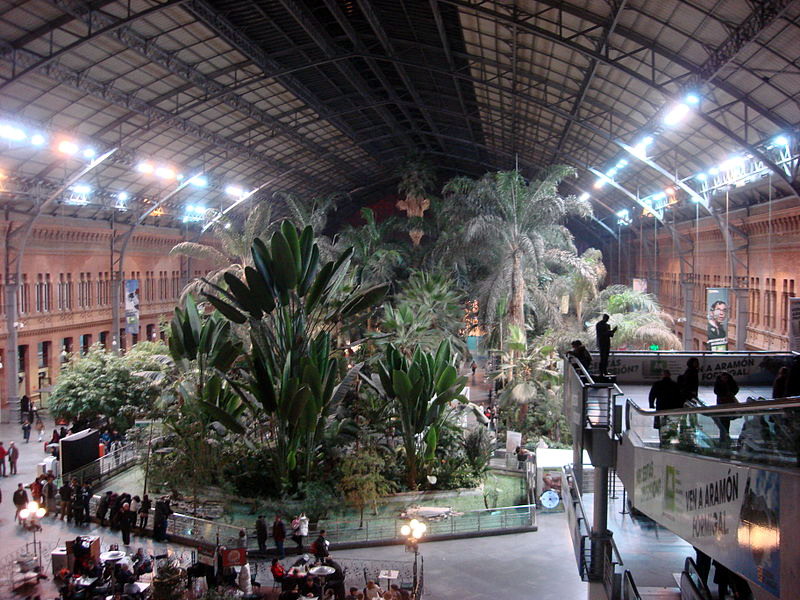
Anyone traveling through Madrid's main Atocha railway station in the last twenty years will remember the beautiful, tropical garden in the station's main concourse. What they might not know is that around 300 turtles have happily taken refuge there.


Basically the tropical garden has now become a welcoming refuge to homeless turtles.
There are many reasons for them being there. Some were brought there because children lost interest in them. Others because for some reason or another they could no longer keep them as pets. Another major reason is that people might not have been prepared, or able, to pay the 40% ticket price to take the turtle on a train and found a quick solution to the problem.
Whatever the reason for them being there, the station's indoor wetlands have been populated with approximately 300 turtles, giving a little glimpse of nature to passengers passing through the station.

The state railway company, Renfe, has employed Aurora Peña to look after the turtles. She told El País: “We give them animal feed, to make sure they are properly nourished.”


Indicating the turtles, grouped on rocks and other platforms in the water, surrounded by fine white sand, she said:

“This is the area we have set aside for them to lay their eggs.”

Explaining that normally turtles living in a tropical sea would head to a remote and protected beach to lay their eggs, and then incubate them, she said that the little expanse of sand in the tropical garden is the closest they will get to a beach in the Spanish capital.

At the last count of the turtles in 2012, when there were 275 animals. “We take them out one by one, we count them and we tidy them up a bit,” says Peña.

According to Peña, the population has stayed relatively stable over the years. Those that have died have been replaced by people's former pets.

Not a bad place for a turtle to end up these days, and as we can see from the video below, definitely a distraction from the boredom of waiting for your train.

The gardens alone are worth the visit. With over 7,000 plants in neatly manicured garden beds, with some reaching the station's domed ceiling, its like another world in the center of the busy city. There are reportedly around 260 different tropical species among the plants, and they even include towering palm trees.

Normally a railway station is somewhere you just pass through when on vacation, but Atocha railway station has actually received reviews on Tripadvisor, mainly for its tropical garden and inhabitants. 


To the source: http://www.digitaljournal.com/article/355469

Sean Penn and Javier Bardem movie blocked by Barcelona bullfight ban

Javier Bardem and Sean Penn have been in Barcelona filming their new movie, "The Gunman," for most of July. However, they have run into a problem filming the bullfighting scene, due to the Catalan ban on the sport.


The film is being produced by French director Pierre Morel, well known for the action movies "The Transporter" and "Taken."

Morel ran into a problem while filming the latest film "The Gunman", which is set partly in Barcelona. The city's Town Hall stopped him from staging the bullfight scene in Barcelona’s La Monumental bullring, saying it would go against animal right laws recently introduced in the region.

Film producer Adrián Guerra told Catalan daily El Periódico, “The scene wasn’t actually going to take place on the arena."

“All we wanted to film were a few bullfighting passes with the cape in the streets and the bullpens, not to actually fight the animals,” he added. 

However Barcelona's Town Hall wishes to disassociate the Catalan capital from Spain’s image of a bullfight-loving society.

It now seems that Morel will get around the problem by using oxen in the scene rather than bulls. His team will have to use computer-generated imagery to make the oxen resemble Lidia bulls on screen.

The bullfighting ban in the Catalunya region was passed in Parliament in 2012 and was supported by animal rights groups, but was opposed by detractors who claimed the practice was “an asset of cultural interest.” 

The video below shows scenes of the filming in Barcelona.

The film is an adaptation of Jean-Patrick Manchete's 1981 war novel, "The Prone Gunman."

The plot of the movie is an international spy must clear his name in order to save himself from the organization that he used to work for. Main stars: Idris Elba, Javier Bardem, Sean Penn.


To the source: http://www.digitaljournal.com/article/355441


World's oldest man credits Anacin and a banana a day for longevity

Born in Salamanca, Spain in 1901, and now living in the USA, 112-year-old Salustiano Sánchez Blázquez has now been announced the world's oldest man, as Japan's Jiroemon Kimura passed away on June 12 at the age of 116.

Now officially named the oldest living man on Earth by the Guinness Book of Records, Blázquez has credited his longevity to a combination of pain killers and bananas.
 
Succeeding Japan's Jiroemon Kimura, who died on June 12 at the age of 116, Blázquez is currently the only male born in 1901 with proof of birth, giving him the award of being the oldest man alive. 
 
Nicknamed Shorty by his friends, the 112-year-old former coal miner now lives close to Niagara Falls in upstate New York in the US. 
 
However, he was born on June 8, 1901 in the village of El Tejado de Béjar in Salamanca province, Spain. As he was growing up, Blázquez was well known for his musical prowess, playing a "dulzaina", (a Spanish double reed instrument in the oboe family). 

Blázquez earned pocket money playing the instrument at weddings and village celebrations and attended school until he was 10. He now considers himself self-taught. 
 
At the age of 17, he moved to Cuba to work on the sugar plantations.  He then traveled to the US, entering via the iconic immigration center on Ellis Island in 1920. 

Blázquez worked as a miner in Kentucky before finally settling in the Niagara area, close to the Canadian border, where he has lived ever since. Blázquez married the love of his life, Pearl, in 1934 and his children include a 76-year-old son, John, and 69-year-old daughter Irene. He also has seven grandchildren, 15 great-grandchildren and five great-great grandchildren. 
 
His hobbies include crossword puzzles, nightly gin rummy games with friends and gardening. 
 
He remains humble despite the prestigious award and “does not feel he has accomplished anything special because he happens to be living longer than other men.”
 
In a statement, Blázquez said that he had lived to such an old age due to a daily dose of six tablets of Anacin (a pain-reliever containing aspirin and caffeine) and a banana. 
 
However, his daughter, 69-year-old Irene Johnson, says, "I think it's just because he's an independent, stubborn man." 
 
Anacin's manufacturer, Insight Pharmaceuticals was happy to hear that their product may have helped him live so long and will now be exploring the possibility of a new product: 
 
"Historically, apples are the fruit most associated with staying healthy and avoiding doctors," said marketing vice-president Jennifer Moyer.
 
"Our scientists had never looked into the banana before. But now that the certified oldest man in the world credits bananas and Anacin as his life-extending combo, we're certainly going to explore whether a new 'Bananacin' product makes sense.
 
To the source: http://www.digitaljournal.com/article/355439